

Nearly 75% of people say paid ads help them find what they need online. With search results more crowded than ever, understanding PPC advertising means the difference between blending in and standing out. By mastering its core concepts and platforms, you can reach the right customers, control your costs, and see results you can measure right away.
Key Takeaways
| Point | Details |
|---|---|
| PPC Mechanics | PPC advertising involves bidding on keywords, allowing businesses to pay for clicks from targeted audiences rather than organic traffic. |
| Targeting Diversity | Businesses can leverage various PPC campaign types across platforms like Google, Facebook, and LinkedIn for precise audience targeting. |
| Performance Measurement | Real-time performance data enables quick adjustments, emphasizing the importance of metrics like CPC, conversion rates, and customer acquisition costs. |
| Ongoing Optimization | Continuous refinement of campaigns is essential to avoid common PPC pitfalls and maximize engagement and ROI. |
Table of Contents
- Defining Ppc Advertising And Core Concepts
- Types Of Ppc Campaigns And Platforms
- How Ppc Advertising Works In Practice
- Benefits And Challenges Of Ppc For Businesses
- Costs, Roi, And Common Mistakes To Avoid
Defining PPC Advertising and Core Concepts
At its core, Pay-Per-Click (PPC) advertising is a powerful digital marketing strategy where businesses pay a small fee each time someone clicks on their online advertisement. According to Wikipedia, this internet advertising model allows brands to essentially purchase website visits rather than earning them organically through traditional search engine optimization techniques.
The fundamental mechanism of PPC involves advertisers bidding on specific keyword phrases relevant to their target audience. When users search these keywords, the advertiser’s ads appear in prominent positions on search engine results pages or social media platforms. As research indicates, the cost per click depends on several critical factors:
- Ad Quality Score: How relevant and compelling your advertisement is
- Keyword Competition: How many other businesses want the same search terms
- Click-Through Rate (CTR): The percentage of people who click after seeing the ad
Unlike traditional advertising where you pay for potential exposure, PPC offers a more accountable model. According to cost-per-action research, advertisers set maximum bids per click and only pay when genuine user interaction occurs. This approach creates a transparent, performance-driven marketing strategy that allows precise budget control and immediate measurability of campaign effectiveness.
Think of PPC as a digital auction where your ad’s visibility is determined by a combination of your willingness to pay and the ad’s perceived value to potential customers. The more strategically you approach keyword selection, ad design, and landing page optimization, the more cost-effective your campaigns become.
Types of PPC Campaigns and Platforms
PPC advertising offers a diverse landscape of campaign types and platforms, giving businesses multiple strategies to reach their target audiences. According to Wikipedia, these campaigns span across various digital environments, from search engines to social media networks, each with unique targeting capabilities and audience interactions.
Search Ads represent the most traditional PPC format, appearing directly in search engine results when users query specific keywords. Platforms like Google Ads, Microsoft Advertising, and Amazon Advertising dominate this space, allowing businesses to bid on relevant search terms and display targeted advertisements precisely when potential customers are actively seeking related products or services.
Social media platforms offer sophisticated targeted advertising options that go beyond keyword matching. As research indicates, platforms including:
- Facebook and Instagram (demographic and interest-based targeting)
- LinkedIn (professional network targeting)
- TikTok and Twitter (behaviour and engagement-based targeting)
- Pinterest (interest and lifestyle-based targeting)
These platforms enable highly granular audience segmentation, allowing businesses to craft campaigns that reach specific demographics, professional groups, or interest clusters.
 Display and Remarketing Ads further expand PPC possibilities, enabling visual banner advertisements and strategic re-engagement with previous website visitors, creating multiple touchpoints in the customer journey.
Here’s a comparison of major PPC campaign types and their key characteristics:
| PPC Campaign Type | Main Platforms | Targeting Method |
|---|---|---|
| Search Ads | Google Ads Microsoft Advertising Amazon | Keyword search intent |
| Social Ads | Facebook TikTok | Demographics Interests Behaviour |
| Display Ads | Google Display Network Programmatic platforms | Website placements Contextual |
| Remarketing/Retargeting | Google Ads Specialist tools | Past site visitors Custom audiences |
How PPC Advertising Works in Practice
PPC advertising operates like a strategic digital auction where businesses compete for targeted visibility. According to Wikipedia, the fundamental mechanism involves advertisers bidding on specific keywords relevant to their target market, with ads appearing when users enter matching search queries.
The process begins with keyword selection and bid strategy. Advertisers determine how much they’re willing to pay for each potential customer click, balancing budget constraints with potential return on investment. Ad placement is not simply about having the highest bid – search engines like Google also consider ad quality score, which evaluates factors such as:
- Relevance of the ad text
- Expected click-through rate
- Landing page experience
- Historical performance of the advertisement
Modern PPC has been revolutionized by artificial intelligence and machine learning technologies. As research indicates, these advanced systems can optimize ad placement and bidding strategies, potentially increasing click-through rates by up to 15%. Small and medium enterprises can now efficiently allocate approximately 45% of their marketing budgets to PPC, leveraging precise targeting and scalable advertising approaches that were previously accessible only to large corporations.
The real power of PPC lies in its immediate measurability and flexibility. Advertisers receive real-time data on ad performance, allowing rapid adjustments to targeting, messaging, and budget allocation. This dynamic approach transforms digital advertising from a guessing game into a data-driven, strategic marketing tool that delivers transparent, trackable results.
Benefits and Challenges of PPC for Businesses
Pay-Per-Click advertising offers businesses a powerful, nuanced digital marketing approach with compelling advantages and notable complexities. According to research from Web Pro News, PPC provides small and medium enterprises unprecedented opportunities to compete in digital marketing spaces traditionally dominated by larger corporations.
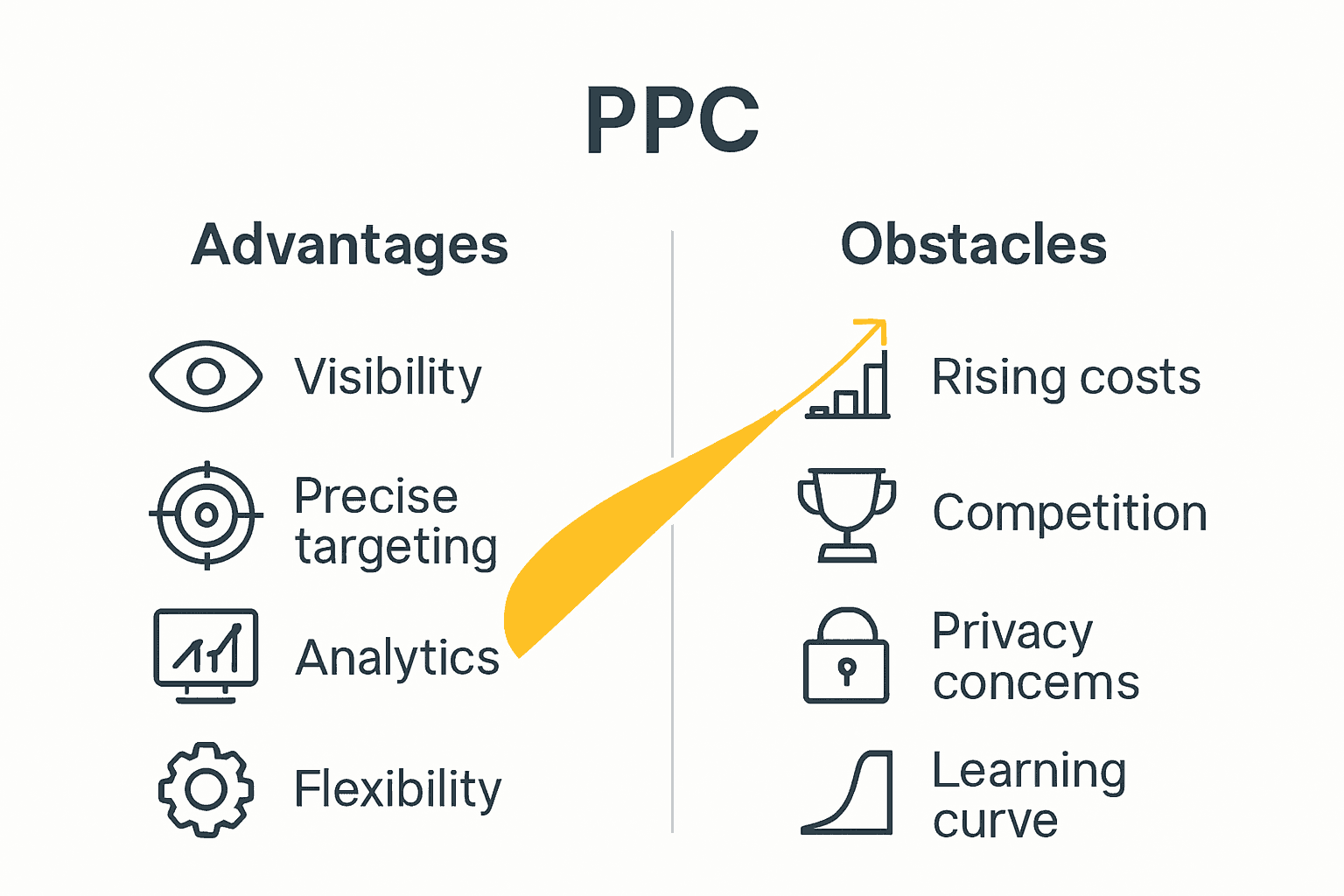
The key benefits of PPC include:
- Immediate visibility in search results
- Precise audience targeting
- Real-time performance tracking
- Flexible budget management
- Quick campaign deployment and adjustments
However, PPC is not without significant challenges. As industry research indicates, businesses face rising costs and increasing competition for keywords. The average cost-per-click continues to grow, making strategic budget allocation critical. Privacy regulations and data tracking limitations are creating additional complexity, requiring marketers to become increasingly sophisticated in their targeting approaches.
Businesses must carefully evaluate their digital marketing investment when considering PPC. While the model offers remarkable potential for rapid customer acquisition, success demands continuous optimization, deep understanding of platform algorithms, and a willingness to adapt quickly to changing digital landscapes. The most successful PPC strategies blend technical expertise with creative messaging, ensuring that every advertising dollar generates meaningful engagement and potential conversions.
Costs, ROI, and Common Mistakes to Avoid
PPC advertising requires strategic financial planning and careful execution to ensure meaningful returns on investment. The costs can vary dramatically, ranging from a few dollars to hundreds per click depending on your industry, competition, and chosen platforms, making precise budget management critical for success.
Understanding Return on Investment (ROI) involves tracking several key performance indicators:
- Cost per Click (CPC): Your direct advertising expense
- Conversion Rate: Percentage of clicks resulting in desired actions
- Customer Acquisition Cost: Total spend divided by new customers gained
- Lifetime Customer Value: Projected revenue from each acquired customer
Businesses frequently encounter several common PPC pitfalls that can drain budgets and reduce effectiveness. These include:
- Targeting overly broad keywords
- Neglecting negative keyword strategies
- Failing to optimize landing pages
- Ignoring mobile user experience
- Not performing regular performance audits
To maximize your conversion optimization potential, it’s crucial to continuously refine your approach. Successful PPC campaigns demand ongoing attention, testing, and strategic adjustments. Think of your PPC strategy like a living organism – it needs constant nurturing, monitoring, and adaptation to deliver consistent, meaningful results that genuinely grow your business.
Ready to Take Control of Your PPC Results?
Trying to navigate the ever-changing world of Pay-Per-Click advertising leaves many business owners feeling uneasy about spiralling costs, missed opportunities and wasted budgets. If you have read about the importance of ad quality, conversion optimisation and precise targeting in our Complete Guide to PPC Advertising for Business Growth, you understand just how complex and competitive this field can be. For practical strategies and ongoing tips, explore our dedicated Marketing Helpful Tips library, where we break down advanced PPC tactics into actionable steps.
Do not let indecision or inexperience stall your growth. Resen Digital specialises in tailoring PPC campaigns that deliver measurable results, helping Australian businesses cut through the noise and achieve genuine scale. Connect with a local team that blends over 25 years of specialist experience with a relationship-first approach. Secure your free digital audit now via our Contact Us page and see what a strategic partnership can do for your business. Looking to build a foundation for long-term growth? Explore more ways we can help on our Digital Marketing page.
Frequently Asked Questions
What is PPC advertising and how does it work?
PPC, or Pay-Per-Click advertising, is a digital marketing strategy where businesses pay each time someone clicks on their ad. Advertisers bid on keywords relevant to their audience, and ads appear in search results or on social media platforms, depending on those bids and the ad quality.
What are the main types of PPC campaigns available?
The main types of PPC campaigns include Search Ads (on platforms like Google Ads), Social Ads (on platforms like Facebook and LinkedIn), Display Ads (visual banners on the web), and Remarketing Ads (targeting previous site visitors). Each type uses different targeting methods to reach potential customers effectively.
How can businesses measure the success of their PPC campaigns?
Businesses can measure PPC success by tracking several key metrics such as Cost Per Click (CPC), Conversion Rate, Customer Acquisition Cost, and Lifetime Customer Value. These indicators help evaluate performance and return on investment (ROI).
What are common mistakes to avoid in PPC advertising?
Common mistakes in PPC advertising include targeting overly broad keywords, neglecting negative keyword strategies, failing to optimize landing pages, ignoring mobile user experience, and not regularly auditing campaign performance.
