

Did you know that over 90 percent of consumers search online before making a purchase decision? Your digital presence often shapes a customer’s first impression, yet many businesses remain invisible where it matters most. Understanding where your website stands can reveal hidden opportunities and weaknesses. By taking clear steps to assess, improve, and monitor your online visibility, you lay the groundwork for steady growth and real results.
Table of Contents
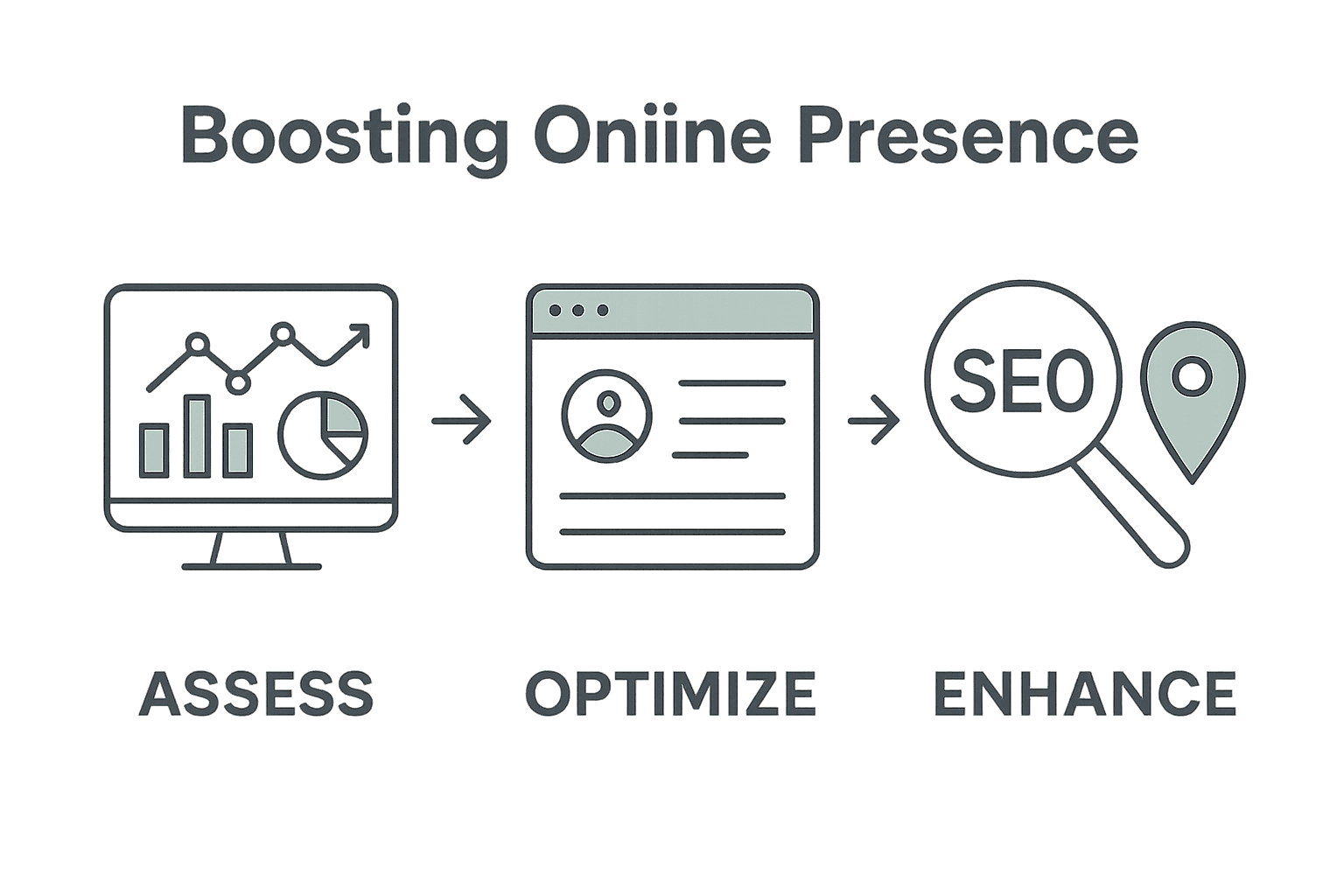
- Step 1: Assess Current Online Visibility
- Step 2: Optimize Website For User Experience
- Step 3: Enhance SEO And Local Listings
- Step 4: Leverage Paid Advertising Effectively
- Step 5: Monitor Results And Refine Strategies
Quick Summary
| Key Point | Explanation |
|---|---|
| 1. Assess Online Visibility | Evaluate website performance using analytics for better understanding. |
| 2. Optimize User Experience | Enhance navigation and design for improved visitor engagement. |
| 3. Improve SEO and Local Listings | Target local keywords and maintain consistent business information. |
| 4. Leverage Paid Advertising | Develop focused ads across multiple platforms for wider reach. |
| 5. Monitor and Refine Strategies | Regularly track metrics and adjust strategies for continuous improvement. |
Step 1: Assess Current Online Visibility
Assessing your current online visibility is the foundational step in understanding how your business performs digitally. This process involves systematically evaluating your website’s performance and digital footprint to identify strengths and areas for improvement.
According to UKRI, monitoring user statistics is crucial for understanding visitor interactions. Start by gathering key metrics from tools like Google Analytics to examine critical data points such as:
- Total website visitors
- Traffic sources
- Device usage patterns
- Most visited pages
- Average time spent on site
- Bounce rates
In addition to quantitative data, Queen’s University Belfast recommends evaluating your website’s usability and content quality. Perform a comprehensive review by checking website navigation, content relevance, and overall user experience. This means putting yourself in your customers’ shoes and critically assessing whether your digital presence effectively communicates your brand message and meets user expectations.
Pro Tip: Use free online tools like Google’s PageSpeed Insights to assess technical performance and identify potential improvements in site speed and mobile responsiveness. These technical aspects significantly impact user experience and search engine rankings.
With this initial assessment complete, you’ll have a clear roadmap of your digital strengths and opportunities. The next step will involve developing a targeted strategy to enhance your online visibility and engage potential customers more effectively.
Step 2: Optimize Website for User Experience
Optimizing your website for exceptional user experience is critical to converting visitors into customers and keeping them engaged. This step involves creating a seamless digital environment that intuitively guides users through your content while meeting their expectations.
According to University of Washington, enhancing user experience requires understanding user needs through comprehensive research and creating intuitive navigation. Start by mapping out your website structure to ensure visitors can find information quickly and easily. This means developing clear menu categories, logical page hierarchies, and prominent call-to-action buttons that guide users naturally through their journey.
UKRI emphasizes the importance of a professional design that reflects your brand. Focus on creating a visually appealing layout with readable fonts, appropriate color contrasts, and consistent styling. Prioritize accessibility by ensuring your design works well across different devices and screen sizes.
Pro Tip: When designing your website user experience, always test your site from a user perspective. Ask colleagues or potential customers to navigate your website and provide honest feedback about their experience. Their insights can reveal navigation challenges you might have overlooked.
By systematically improving your website’s user experience, you create a digital environment that not only looks professional but also effectively communicates your brand message and meets user expectations.
 The next step will involve implementing strategic content that keeps visitors engaged and drives conversions.
Step 3: Enhance SEO and Local Listings
Enhancing your online visibility through strategic SEO and local listings is crucial for attracting potential customers and establishing your digital presence. This step focuses on optimizing your online footprint to improve search engine rankings and local discoverability.
According to the British Council, establishing an effective online presence involves creating user friendly platforms that engage customers. Begin by implementing SEO optimisation strategies that target relevant keywords specific to your business and local market. This includes:
- Researching local search terms
- Optimizing website content with targeted keywords
- Creating location specific meta descriptions
- Ensuring consistent business information across online platforms
Focus on building robust local listings by claiming and verifying your Google Business Profile, Bing Places, and other regional directory listings. Ensure your business name, address, phone number, and website are identical across all platforms. This consistency helps search engines validate your business information and improves local search rankings.
Pro Tip: Regularly update your local listings with fresh content like photos, customer reviews, and current business hours. These dynamic elements signal to search engines that your business is active and relevant.
By systematically improving your SEO and local listings, you create multiple digital touchpoints that increase your visibility and make it easier for potential customers to find and connect with your business.
The next step will involve leveraging social media and content marketing to further amplify your online presence.
Step 4: Leverage Paid Advertising Effectively
Leveraging paid advertising is a strategic approach to rapidly expand your online visibility and attract targeted customers. This step involves creating a focused digital marketing strategy that maximizes your advertising budget and drives meaningful engagement.
According to the British Council, effectively leveraging paid advertising requires establishing user friendly platforms that enhance customer engagement. When developing your PPC advertising strategy, concentrate on these key elements:
- Defining clear target audience demographics
- Selecting appropriate advertising platforms
- Crafting compelling ad copy and visuals
- Setting realistic budget allocations
- Implementing precise tracking mechanisms
Focus on diversifying your paid advertising approach across multiple channels including Google Ads, Meta Ads, LinkedIn Advertising, and industry specific platforms. Each platform offers unique targeting capabilities that allow you to reach potential customers with precision. Develop distinct ad sets for different customer segments and continuously monitor performance metrics to refine your strategy.
Pro Tip: Start with smaller budget experiments to test different ad variations and audiences before scaling up. This approach minimizes financial risk while providing valuable insights into what resonates with your target market.
By systematically implementing a data driven paid advertising strategy, you create multiple pathways for potential customers to discover and engage with your business. The next step will involve measuring and analysing your digital marketing performance to ensure continuous improvement.
Step 5: Monitor Results and Refine Strategies
Monitoring and refining your digital marketing strategies is crucial for sustained online success. This step focuses on transforming raw data into actionable insights that drive continuous improvement and business growth.
UKRI emphasizes the importance of regularly monitoring user statistics to understand visitor behavior and make data driven decisions. Utilize comprehensive analytics tools like Google Analytics to track key performance indicators such as:
- Website traffic volume
- Visitor engagement rates
- Conversion percentages
- Traffic sources
- User behavior patterns
- Bounce rates
According to University of Washington, continuous improvement involves systematic testing and refining based on user feedback. Develop a structured approach to website content strategy by conducting regular performance reviews. Compare your current metrics against previous benchmarks and industry standards to identify areas of potential optimization.
Pro Tip: Create a monthly dashboard that consolidates your key metrics. This visual representation will help you quickly identify trends, celebrate successes, and pinpoint areas requiring immediate attention.
By consistently monitoring and adapting your digital strategies, you transform data into a powerful tool for business growth. This iterative process ensures your online presence remains dynamic, responsive, and aligned with your business objectives.
Elevate Your Online Presence with Expert Digital Solutions
The challenge of boosting your online presence involves mastering complex areas like SEO optimisation, user experience design, and paid advertising strategies as discussed in the article. Understanding these critical components and applying them effectively can feel overwhelming, especially when every moment counts towards engaging your local audience and outperforming competitors. You need tailored support that transforms these strategies into tangible growth and increased customer engagement.
At Resen.com.au, we specialise in helping businesses like yours tackle these pain points with a human-centred approach and proven expertise. Whether you are looking to optimise your website’s user experience, refine your SEO tactics, or leverage powerful paid advertising, our team offers comprehensive solutions including Marketing Helpful Tips and guidance on Accessibility to ensure every visitor feels valued. Take the first step towards measurable success today by connecting with us for a free digital audit at Resen contact page.
Don’t let uncertainty slow your growth. Act now to unlock the full potential of your online presence with strategies designed for your unique business needs and local market influence.
Frequently Asked Questions
How can I assess my current online visibility?
Start by gathering key metrics such as total website visitors, traffic sources, and bounce rates. Use Google Analytics to analyze this data to identify strengths and areas to improve over the next 30 days.
What steps should I take to optimize my website for user experience?
Create an intuitive navigation structure that allows users to find information easily. Map out your website’s menu categories and ensure clear call-to-action buttons are present to guide users naturally through their journey.
How can I enhance my SEO and local listings?
Optimize your website content with relevant local keywords and ensure that your business information is consistent across all platforms. Claim your Google Business Profile and update it regularly with fresh content, which can boost local search visibility within a few weeks.
What elements should I focus on in my paid advertising strategy?
Define clear target audience demographics and select appropriate advertising platforms for your campaigns. Craft compelling ad copy and set realistic budgets to test different ad variations within 30 days to see what resonates best with your audience.
How do I effectively monitor results and refine my online strategy?
Regularly track key performance indicators like website traffic and conversion rates using a comprehensive analytics tool. Create a monthly performance dashboard to consolidate your metrics and easily identify improvement areas, then adjust your strategies based on this analysis.
What is the timeline for seeing improvements in my online presence?
Improvements can typically be observed within 30–60 days of implementing changes like optimizing your website or enhancing your local listings. Consistently monitor your metrics to determine the effectiveness of each initiative as you move forward.
